
Pandora's Box Has a Lobster on It Now
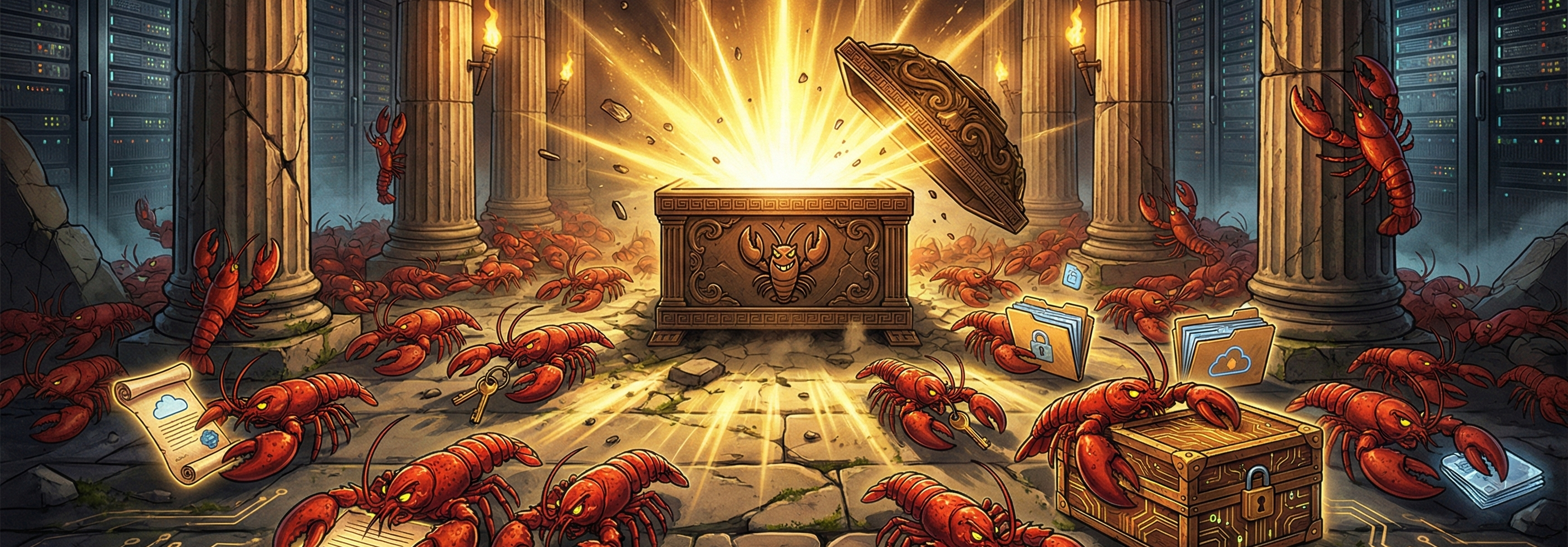
I've watched this industry open Pandora's Box so many times that I've lost count. Every few years, something comes along that makes the security community collectively lose its mind, vendors scramble to publish breathless blog posts, and CISOs quietly update their resumes. The cloud was going to be the end of us. BYOD was going to be the end of us. Shadow IT was going to be the end of us. Generative AI was going to be the end of us.
We're still here. But we're tired.
OpenClaw, the open-source AI agent formerly known as Clawdbot, then Moltbot, because apparently rebranding twice in a week is just how we do things now, is the latest entry in the long and storied tradition of technologies that are genuinely useful, genuinely dangerous, and completely impossible to put back in the box once they're out. If you haven't been paying attention, here's the short version: it's an autonomous AI agent that lives on your device, connects to your messaging apps, reads your email, manages your calendar, runs shell commands, installs its own software, and remembers everything about you forever. It's being described as "AI with hands," which is a phrase that should make every security professional's blood run cold.
And people are installing it on their work machines. Connected to corporate infrastructure. With access to enterprise credentials.
Of course they are.
We've seen this movie before...
If you've been in this industry long enough, you develop a sixth sense for when something is going to cause you pain. OpenClaw triggered that instinct the moment I read that it stores credentials in plaintext and ships with no authentication by default. A security audit back in January found over 500 vulnerabilities, eight of them critical. Researchers have already discovered more than 42,000 instances exposed on the open internet. Cisco tested a third-party "skill", which is OpenClaw's version of a plugin marketplace, and watched it silently exfiltrate data and inject prompts without the user knowing anything had happened.
None of this is surprising. It follows the exact same pattern we've seen with every transformative technology for the last three decades. The pattern goes like this: something genuinely useful emerges, early adopters rush in, security is an afterthought, researchers start screaming, vendors start selling, and eventually... eventually, we get some semblance of controls. Lather, rinse, repeat.
But here's what makes OpenClaw different from the last few rounds of Pandora's Box, and why I think it deserves serious attention even from those of us who are tired of the hype cycle.
The SaaS Control Problem Just Got Exponentially Harder
We were just starting to get a handle on SaaS security. I mean just starting. After years of cloud applications being treated as ungovernable black boxes, companies like Turngate, SaaS Alerts, Wing Security, and Obsidian Security were finally scratching the surface of forcing SaaS vendors to behave like responsible members of the enterprise ecosystem. We were getting visibility into audit logs that used to be opaque. We were getting controls over OAuth integrations that used to be invisible. We were starting to answer questions like "who has access to what" and "what did they do with it". Questions that sound embarrassingly basic until you realize how many enterprises still can't answer them.
Identity was having its moment. After decades of being the unglamorous plumbing of information security, identity and access management was finally being recognized as the centerpiece of a modern security program. Every CISO I knew was investing in it. Every board presentation had an identity slide. We were building the muscle to manage SaaS sprawl, to govern integrations, to monitor for anomalous behavior across interconnected cloud services.
And then someone decided that what we really needed was for any random GitHub repository to become a potential piece of code with direct access to corporate infrastructure, running autonomously, with persistent memory, and the ability to install additional tools on its own.
We went from "we're finally getting SaaS under control" to "the Wild West is back" in about a week.
The OneDrive Problem (And Everything Like It)
Here's a thought exercise that should keep you up at night: How do you stop a OneDrive-synced folder from being processed by OpenClaw?
The answer, as of right now, is that you probably don't. Not easily. Not at scale. And not without going right back to being the department of "No".
OpenClaw doesn't show up in your server logs like a traditional crawler. It's running locally on someone's machine, acting through their browser, using their credentials, operating indistinguishably from the user themselves. It's not making API calls from a suspicious IP range. It's not using a recognizable user agent string. It's just... the user. Except it's not.
This is the nightmare scenario that DLP vendors have been warning about for years, except the data isn't leaving through a browser upload to a personal Dropbox account or an email to a personal Gmail. It's leaving through an AI agent that has been given the keys to the kingdom by a well-meaning employee who just wanted to automate their inbox management.
Every document in that synced folder. Every file the agent can reach. Every credential stored in a configuration file, every API key in a .env file, every OAuth token in a browser session, all of it is now within the blast radius of a tool that was explicitly designed to read, process, and act on everything it can access.
And the skills marketplace "ClawHub", they call it, has already been found to harbor hundreds of malicious extensions. Researchers have documented skills that exfiltrate data, establish reverse shells, harvest credentials from OpenClaw's own configuration files, and deploy stealer malware that activates only when the user interacts naturally with the agent, making it invisible to static analysis. We're essentially watching an app store supply chain attack unfold in real time, except instead of a mobile app with sandboxed permissions, the compromised code has root-level access to enterprise endpoints.
DLP's Coronation
For the last several years, if you asked me what domain was going to define the next era of cybersecurity, I would have said identity without hesitation. Identity was the new perimeter. Zero Trust was built on identity. Every major breach traced back to compromised credentials or excessive access.
I still believe all of that. But I think OpenClaw, and everything that follows it, because there will be more, is accelerating a shift that was already underway. Data Loss Prevention, the discipline that has been the "too hard to implement" stepchild of the security program for as long as I can remember, is becoming essential in a way it never has been before.
Here's why: identity tells you who has access. DLP tells you where the data is actually going.
When an autonomous AI agent is operating with a user's credentials, behaving as that user, and making decisions about what data to read, process, summarize, and transmit, identity controls alone aren't enough. The identity is valid. The authentication is legitimate. The access is authorized. But the data is flowing somewhere you didn't intend, being processed by something you didn't approve, and potentially being exfiltrated through channels you can't see.
DLP has always been hard because it requires you to know what your sensitive data looks like, where it lives, how it moves, and what constitutes unauthorized transmission. Those are genuinely difficult problems. But the alternative, flying blind while autonomous agents roam your infrastructure with full access, is no longer acceptable. The boards that I'm serving on or have served on are just starting to ask hard questions in this space again.
The SaaS security companies I mentioned earlier are going to become even more critical. Turngate's approach to unifying SaaS audit logs, Obsidian Security's behavioral analytics, Wing Security's governance of SaaS applications, SaaS Alerts' monitoring capabilities, we need all of this and more. We need to lean further into these tools, not because they solve the OpenClaw problem directly, but because they give us the visibility layer that everything else depends on. You can't protect data you can't see moving. You can't govern access you don't know exists.
The Box Is Open. Now What?
Gartner is telling enterprises to immediately block OpenClaw downloads and rotate any credentials it may have accessed. CrowdStrike has released a detection and removal content pack. Jamf is publishing analysis for Mac environments. These are all reasonable responses to the immediate tactical problem. They won't last.
The strategic problem is bigger than OpenClaw. OpenClaw is just the first autonomous AI agent to go massively viral. It won't be the last. The architecture it represents, an AI brain with system-level access, persistent memory, a plugin ecosystem, and the ability to take autonomous action, is the future of personal computing. The genie doesn't go back in the bottle. End users are just doing what every company has been trying to do for the last year and a half: integrate AI into useful workflows that simplify menial tasks.
So here's what I'd tell the CISO who's sitting in the chair I used to occupy, staring at this mess and wondering where to start:
First, accept that your users are going to adopt this stuff whether you approve it or not. One of OpenClaw's own maintainers warned that if you can't understand how to run a command line, this tool is too dangerous for you. That warning is being cheerfully ignored by thousands, if not hundreds of thousands of people right now. Shadow AI is the new Shadow IT, and it's moving faster than your acceptable use policy can keep up.
Second, stop treating DLP as a future project. It's a now project. The technical barriers to implementation haven't disappeared, but the cost of not implementing it is rising every week. Start with your most sensitive data. Classify it. Know where it lives. Monitor how it moves. This isn't optional anymore.
Third, lean into the SaaS security ecosystem. The companies building visibility and control layers for your cloud applications are doing work that has suddenly become far more urgent. Evaluate them. Deploy them. Give them the integrations they need to do their job.
Fourth, get your identity hygiene right. Principle of least privilege isn't a suggestion, it's your blast radius limiter. If an employee's OpenClaw instance gets compromised, the damage should be limited to what that employee can access. If that employee is an admin with broad access to production systems, you have a very different problem than if they're a marketing coordinator with access to a shared drive.
Fifth, and I can't stress this enough: talk to your board about this now. Not after the first breach. Not after the first headline. Now. The conversation about autonomous AI agents, data governance, and the limitations of current controls is a conversation every board needs to be having. Frame it in business terms. Frame it in risk terms. But have it.
A Final Thought
I've been doing this long enough to know that the sky isn't actually falling. It never is. OpenClaw won't be the end of enterprise security any more than the cloud was, or BYOD was, or any of the other things that were going to destroy us. We'll adapt. We always do.
But the pace is getting faster, the blast radius is getting wider, and the gap between "exciting new technology" and "enterprise security nightmare" is getting shorter. We used to have years between a technology's emergence and its enterprise adoption. Now we have weeks. OpenClaw went from a hobby project to over 150,000 GitHub stars in days, with organizations scrambling to understand their exposure before they'd even heard the name.
Pandora's Box has a lobster on it this time. The contents are familiar, data exposure, credential theft, supply chain attacks, shadow IT, ungoverned access. The difference is that it's all happening at the speed of an AI agent that doesn't sleep, doesn't forget, and doesn't know when to stop.
Welcome to the next chapter. I'm glad I'm retired.